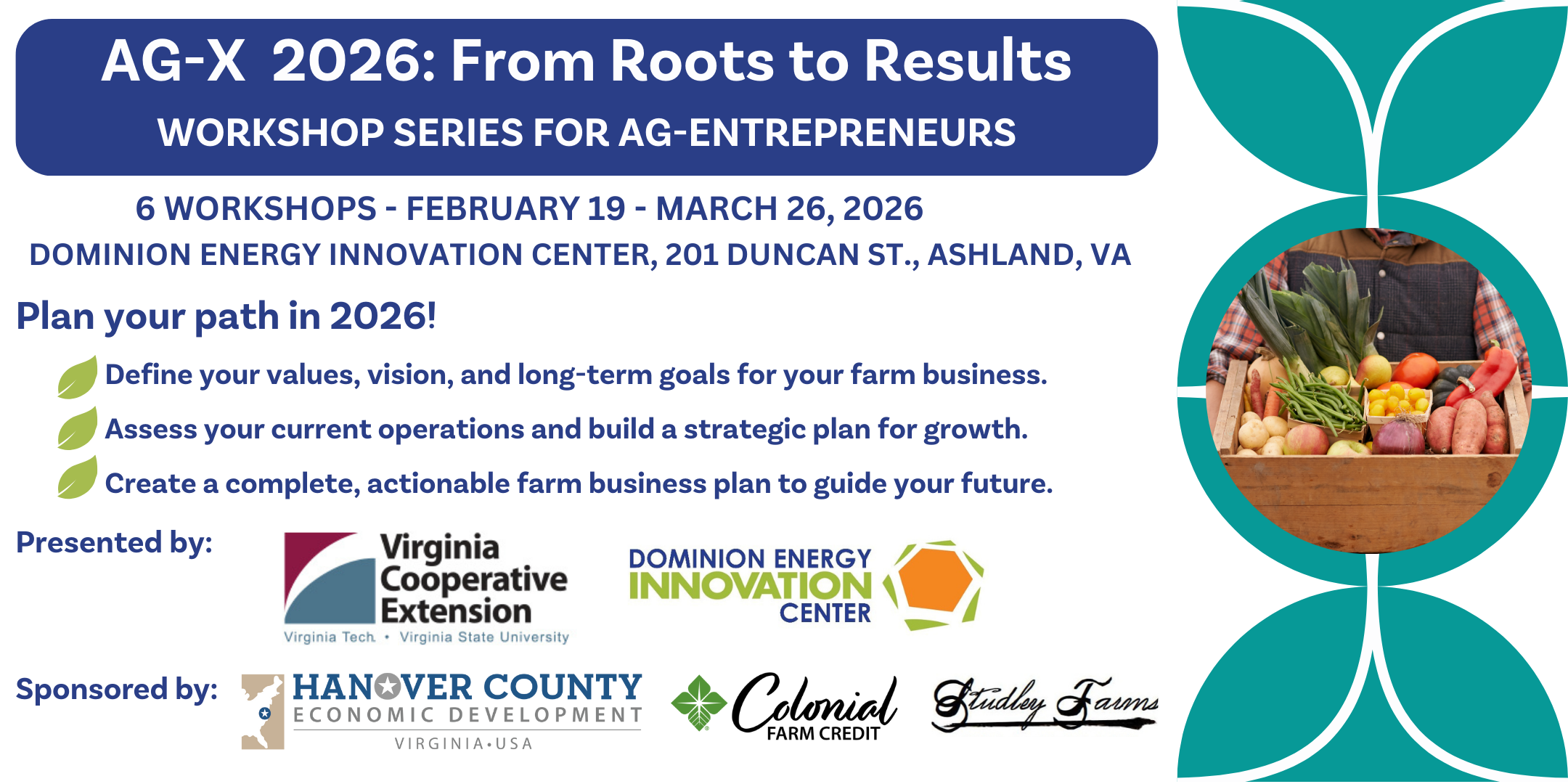
This 6-week evening series is designed to help agricultural producers and farm-based businesses turn ideas into a practical, sustainable business plan. Beginning February 19 and running through March 26, 2026, participants will meet weekly on Thursday evenings from 5:30–7:30 pm to clarify their values and vision, assess their current operation, and develop clear mission statements and goals. Each session builds on the last—covering marketing, operations, human resources, and financial planning—while including tools like SWOT analysis and long-term risk evaluation. By the end of the course, you’ll walk away with a complete, ready-to-implement business plan, action steps, and systems for tracking your progress and guiding future growth.
AG-X also helps agricultural entrepreneurs move from idea to opportunity. The series is intentionally structured to support founders who may be interested in applying to the Center Street Pitch Competition, equipping participants with a strong business foundation, refined story, and clearer financials aligned with the Agriculture & Forestry category. Three entrepreneurs will be selected to present their agricultural or forestry business plan in a five-minute pitch during the showcase on May 7th, 2026. An expert panel will evaluate the pitches and entrepreneurs will compete for a cash prize of $5000 and a DEIC membership.
The AG-X 2026: From Roots to Results is open to businesses of all sizes and sectors, aiming to accelerate growth in the current economic climate. Tailored for entrepreneurs introducing value-added agricultural products, services, or brands, this program empowers ventures like controlled environment agriculture, artisanal cheese, or field monitoring drones.
The cost to participate in the AG-X Workshop Series is $25 per company for up to three team members.
Time & Date: Thursdays, 5:30pm – 7:30pm beginning February 19 until March 26.
Location: DEIC, 201 Duncan St., Ashland, VA 23005
Cost: $25 (Total for all 6 sessions and materials)

February 19, 2026, 5:30pm – 7:30pm
In this opening session, we’ll introduce the course materials and build connections with fellow participants. Together, we’ll explore how your personal, economic, environmental, and community values shape your approach to creating a sustainable agricultural business. By the end of this session, you’ll begin framing your business strategy and setting a clear direction for growth.
February 26, 2026, 5:30pm – 7:30pm
In this session, we’ll take a deeper look at your agricultural business by reviewing its history and current operations. You’ll assess key areas—Marketing, Operations, Human Resources, and Finance—to understand where you stand today. We’ll also conduct a SWOT analysis (Strengths, Weaknesses, Opportunities, and Threats) to help clarify your vision and strengthen your strategic direction.
March 5, 2026, 5:30pm – 7:30pm
This session focuses on planning for the future of your agricultural operation. You’ll craft a clear mission statement, set and prioritize achievable goals, and outline the direction of your business plan. By the end, you’ll have a roadmap with actionable steps to guide implementation and long-term success.
March 12, 2026, 5:30pm – 7:30pm
Guest Speaker: Frank Long, Extension Agent, Agriculture & Natural Resources – Middlesex County
In this session, we’ll dig into the core components of your business plan. You’ll evaluate your marketing strategy, including competition and pricing, examine operational logistics, and address human resource needs and challenges. Finally, we’ll develop a strategic financial plan to ensure your business is positioned for long-term stability and growth.
March 19, 2026, 5:30pm – 7:30pm
This session focuses on evaluating the long-term outlook for your business, including profitability, liquidity, and risk. You’ll identify potential contingencies to address those risks and explore strategic alternatives. By the end, we’ll work toward selecting the most effective, integrated operational strategy to guide your business forward.
March 16, 2026, 5:30pm – 7:30pm
In this closing session, we’ll bring together all the components from previous weeks to create a complete business plan ready for implementation and monitoring. You’ll develop actionable to-do lists, establish record-keeping systems, and set milestones to track progress. We’ll also take time to address any remaining questions and celebrate your achievement.
Scot Ferguson, Virginia Cooperative Extension*
Scot Ferguson is the new Agriculture and Natural Resources Extension Agent in Hanover County. While originally from Nevada where he got his Master’s degree in Natural Resources and Environmental Science, Scot spent the last decade working in production agriculture, focusing on greenhouse production, fertilization, and pest management both in ornamentals and vegetable crops.
*Virginia Cooperative Extension is a partnership of Virginia Tech, Virginia State University, the U.S. Department of Agriculture (USDA), and local governments, and is an equal opportunity employer. For the full non-discrimination statement, please visit ext.vt.edu/accessibility.
Frank Long
Frank Long is a graduate of Virginia Tech with a bachelor’s degree in Agribusiness Management and Applied Economics with a minor in general Political Science. Upon graduation from Virginia Tech, he returned to his native Eastern Shore and to his position on the family farm before accepting the job as Middlesex County’s Agricultural and Natural Resources Extension Agent in 2020. Upon accepting the position as Middlesex County’s Agricultural and Natural Resources Extension Agent, Frank began pursuing his master’s degree in food safety and biosecurity and completed his degree in the spring of 2024. A native Eastern Shore-man, he hails from an established farming family in lower Northampton County and has many years of experience in vegetable and grain production. His other areas of expertise include farm transition planning, oyster production, and integrated pest management planning.